
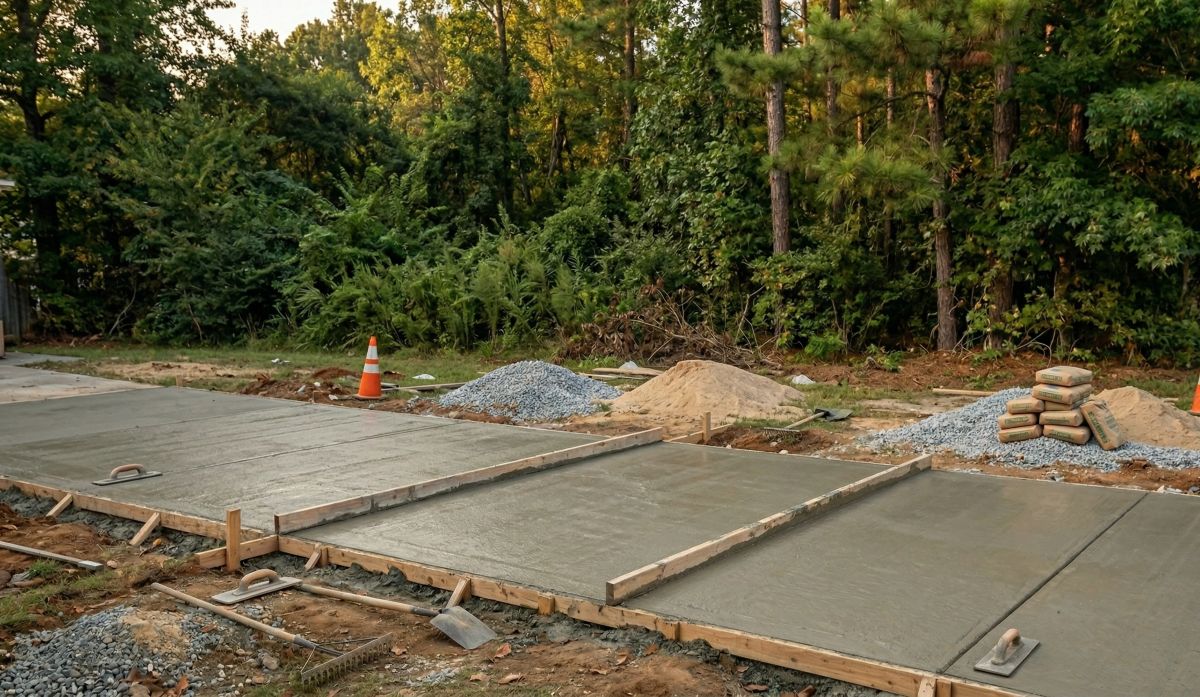

Not every concrete project starts with something to replace — sometimes a property simply needs flatwork that was never there in the first place. This McDonough project captures a fresh concrete driveway pad installation mid-pour, with freshly placed sections still curing in their wooden forms alongside materials staged for the next phase of work. The image tells a familiar story for Georgia homeowners who are tired of parking on bare dirt, gravel, or deteriorating asphalt and want a permanent concrete surface that will serve the property for decades without annual maintenance headaches.
The project shows multiple concrete sections poured in sequence, with properly dimensioned wooden forms holding each slab, a compacted gravel base visible at the perimeter, and fresh aggregate, sand, and bagged cement staged nearby for continued work. Understanding how a concrete flatwork project of this scope gets planned, formed, and finished from the ground up helps homeowners appreciate why proper base preparation and sequenced pouring matter as much as the concrete itself.
Site Preparation and Excavation
Before a single form board goes in the ground, successful concrete flatwork requires excavating the existing soil to the correct depth and establishing a stable, consistent subgrade. Georgia’s clay-heavy soils expand and contract significantly with seasonal moisture changes, making proper excavation depth and subgrade compaction the most important variables in whether a concrete slab holds its position for thirty years or starts settling and cracking within five. The disturbed soil and material staging visible around the perimeter of this project reflects the excavation work completed before forming began.
Removing vegetation, organic material, and unstable topsoil down to firm subgrade — then compacting what remains — creates the foundation that all the visible concrete work above it depends on. Contractors who shortcut this phase produce slabs that look identical at installation but behave very differently once Georgia’s wet and dry seasons begin cycling beneath them.
Gravel Base Installation
The crushed stone aggregate piled alongside the project and visible at the form perimeters represents the compacted gravel base layer installed between the prepared subgrade and the concrete above. A properly installed gravel base — typically four to six inches of compacted crushed stone — serves two critical functions simultaneously. It provides a stable, uniform bearing surface that distributes the concrete slab’s weight evenly, and it creates a drainage layer that allows water migrating through the soil to escape laterally rather than accumulating beneath the slab and causing frost heave or erosion-driven settlement.
Georgia’s red clay is particularly prone to moisture-related movement, making the gravel base layer more than a best practice — it’s the difference between a slab that stays flat and one that develops the humps, dips, and cracks that characterize shortcuts in base preparation. The aggregate piles staged throughout the project confirm this step was executed properly before pouring began.
Forming and Layout
The wooden form boards visible throughout the project photos define the finished edges, thickness, and panel dimensions of each concrete section. Dimensional lumber set at precise heights establishes the finished slab elevation, ensures consistent thickness across the entire pour, and creates the straight, clean edges that define professional flatwork from field-mixed amateur pours. The form layout also determines where control joints will be cut after the pour — the planned weak points that allow concrete’s inevitable shrinkage cracking to occur in straight, predictable lines rather than random fractures across the slab surface.
Proper form setting requires careful measurement, level checking across the full layout, and staking at intervals close enough to prevent the wet concrete’s weight from bowing the boards outward. The tight, consistent form lines visible in the freshly poured sections confirm the layout work that preceded the pour was executed with appropriate care.
The Pour and Finishing Process
The freshly poured concrete sections visible in the project photos are still in their plastic state, showing the steel-troweled surface texture that follows screeding and bull-floating the wet material to its final elevation. Concrete finishing is time-sensitive work — the window between when the surface is workable and when it has hardened past finishing is narrow, particularly on warm Georgia afternoons when heat accelerates the curing process. Multiple finishers working simultaneously across adjacent sections, with tools visible at the slab edges, reflects the crew coordination required to finish large flatwork areas before the concrete sets.
The smooth, consistent surface visible across the completed sections — without aggregate showing through, voids at the edges, or surface tears from finishing too early or too late — reflects experienced timing and technique. Surface finish quality determines both the appearance and the long-term wear characteristics of the finished slab.
Control Joint Planning
The formed panel divisions visible between poured sections serve as construction joints where one pour terminates and the next begins, but control joints within each section will also be tooled or saw-cut at intervals that match the slab thickness. The general rule — joint spacing in feet should not exceed the slab thickness in inches multiplied by 2.5 — means a four-inch slab gets joints every ten feet or less. Proper control joint planning prevents the random cracking that gives poorly planned concrete flatwork its characteristic spider-web fracture patterns within the first few years of service.
For a driveway project in Georgia’s climate, control joint placement also accounts for the direction of dominant thermal expansion and the locations where vehicles consistently load and unload the slab. These details separate concrete work that looks good for decades from work that looks good for a season.
Curing and Strength Development
The bagged cement products staged alongside aggregate piles in the project photo indicate a mix design being batched with careful attention to water-cement ratio — a variable that determines both workability during placement and ultimate compressive strength after curing. Concrete gains strength continuously after placement, reaching approximately 70% of its design strength within seven days and approaching full strength at 28 days. Protecting freshly poured slabs from rapid moisture loss during Georgia’s warm, sometimes dry conditions through curing compounds or wet curing methods ensures the surface achieves its intended durability.
Vehicles and heavy loads should stay off new concrete for a minimum of seven days, with full load capacity reached after the 28-day cure period. Homeowners who understand this timeline protect their investment during the period when the concrete is most vulnerable to surface damage from premature loading.
Concrete Flatwork by Rock and Concrete Company
Durable concrete driveways, pads, and flatwork start with proper excavation, compacted gravel bases, accurate forming, and experienced finishing — and every one of those steps requires the knowledge and discipline that separates concrete that lasts from concrete that doesn’t. Rock and Concrete Company brings comprehensive flatwork expertise to projects throughout McDonough, GA, delivering properly prepared, correctly formed, and professionally finished concrete surfaces that Georgia homeowners can depend on for decades. From driveway pads and parking areas to walkways and patio slabs, every project receives the foundational attention that makes the visible results last. Contact Rock and Concrete Company at (470) 696-7496 to get your concrete project started.